


.svg)


.svg.png)
This is the third installment in a series on the symbolism of demographic collapse and how to make it through such a collapse (I first wrote Is this the Flood? Is Babel Next?, and then Rome Cut Off, Israel Regrafted). Thanks to the articles published so far, I’ve had the chance to speak with two Orthodox Jews who read them: Yosef Razin and Chezi Spero. This article digs into the theology of one trick they pointed out to me, namely matrilocality (i.e., young couples living near the bride’s family, and being supported by them).
In Eastern Europe, Jews developed such a practice called “kest”, where a young married man would live with or be supported by his wife’s parents to live nearby while he continued Torah study.1 Being young and not yet economically independent, such a young man couldn’t immediately found a separate household on his own resources, especially without abandoning his studies. In consequence, the wife’s family sustained him so that he could keep learning and also raise a family. After his studies were completed, he might become a rabbi, but more likely learn a regular trade, often from his father-in-law, and settle into a career.
Note that kest should be distinguished from ordinary dowry. In dowry, the bride’s family gives wealth with the daughter as she enters marriage; the wealth helps establish the household economically, but does not bind the man to live nearby and study theology. In other words, kest gives the bride’s family a lot of influence on the young couple, compared to dowry, and is meant for spiritual as well as family-building purposes.
Historically, when Jews were surrounded by often hostile gentiles, kest helped them maintain their tradition while still raising large families.
Now, modern Haredi (often called “ultra-orthodox”) “kollel” culture is an intensification of kest, especially in Israel.2
Kest was often temporary, familial, and directed toward an elite son-in-law. Kollel is institutional, communal, and in some Haredi contexts much more generalized. The older pattern was that the wife’s parents support the young scholar for a limited time. The modern pattern is often that the wife, parents, in-laws, community, philanthropists, stipends, and, in Israel, even the state itself support the married learner.
This is an important scale shift. What was once the support of a gifted son-in-law becomes, in some communities, an entire social ideal. There are currently tens of thousands of young married men studying Torah full time in Israel while also raising large families. This is a great strategy to not only maintain but grow a culture in a hostile world. It’s an important reason why Israel is the only industrialized nation in the world that enjoys a birth rate above replacement, by a wide margin.
Now, my goal in this article will be to dig into the theology of this pattern of matrilocality to see whether it could be useful for Christians today, and if so, how. I don’t think it will be possible to blindly copy Jews, who are after all a very different people, but I will explain that at least some Christians have already adopted some form of matrilocality, and that it might be worth considering doing more with your sons-in-law, should you have some.
A man shall leave his father and his mother and cleave to his wife
Genesis 2:24 seems to imply matrilocality, but throughout the Bible, this is not the ordinary direction of marriage. Normally, the woman leaves her father’s house and enters the house of her husband. Rebekah leaves her family to go to Isaac. Tamar is bound to Judah’s household through his sons. Ruth is brought into the house and inheritance of Boaz. The biblical world is broadly patrilocal; i.e., it is organized around the father’s house.
It is in fact in situations of exile that matrilocality happens systematically, from Jacob to Christ. Genesis 2 seems to be speaking prophetically about saints and Jesus Himself who will have to undergo exile and matrilocality, more so than it describes the normative majority of marriages.
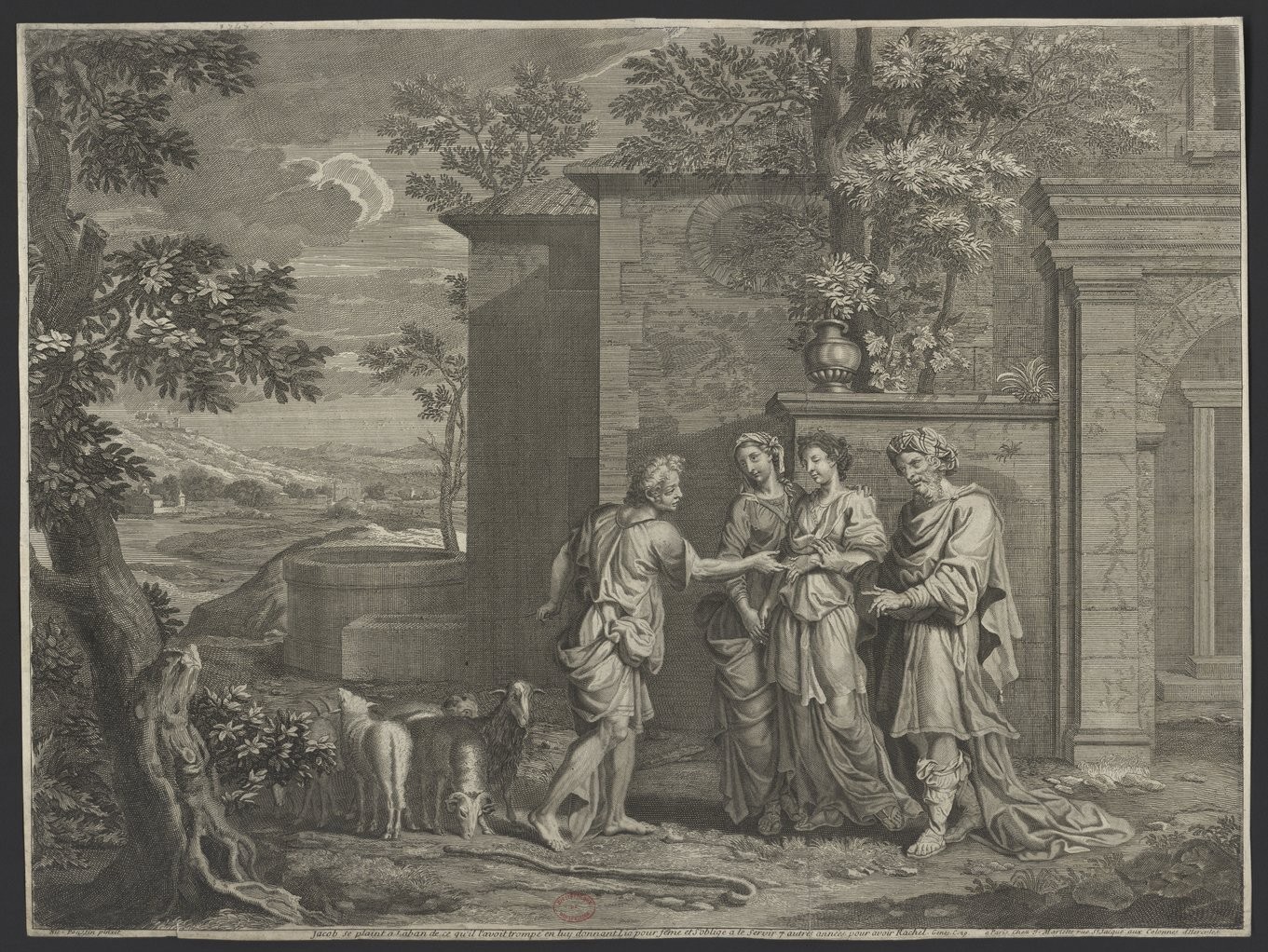
Jacob arrives at Laban’s house as a displaced man. He is not an established patriarch coming with land, flocks, servants, and a bride-price. He is fleeing. He has no household of his own in that place. So he enters the house of Laban, works for Laban, marries Laban’s daughters, and remains for years under Laban’s economic authority.
Moses follows the same pattern. He flees Egypt after killing the Egyptian. He sits by a well in Midian, defends the daughters of Reuel or Jethro, and then he is brought into Jethro’s household. He receives Zipporah as wife while dwelling with her father. Before Moses can return to Egypt as deliverer, he must become a shepherd in the house of his father-in-law.
This seems to be the pattern: when the man has land, clan, name, inheritance, and protection, the woman is usually drawn into his house. But when the man is exiled, vulnerable, landless, or unfinished, he may enter the house of the woman. The wife’s house receives the man in passage, who is thus sheltered, fed, tested, and instructed by the household of the woman before he can become what he is called to become.
Joseph belongs to this pattern, though in a different mode. He too is cut off from his father’s house. He is betrayed by his brothers, sold into Egypt, enslaved, imprisoned, and finally raised by Pharaoh. When he receives Asenath as wife, daughter of Potiphera priest of On (Gen. 41:45), he is not returning to Jacob’s tents to establish a Hebrew household. He is being incorporated into Egypt. His marriage is part of his enthronement in a foreign civilization.
So Joseph is not matrilocal in the simple residential sense. The text does not say that he lives with his father-in-law as Jacob lives with Laban or Moses with Jethro. But he is matrilocal in a broader symbolic sense: the exiled son is re-housed through the bride’s world. Through Asenath, Joseph enters Egypt not merely as an administrator, but as a man with a place, a name, sons, and a future inside the land of exile.
Joseph and Moses should in fact be placed side by side more carefully, since both marry daughters of foreign priests. Joseph marries Asenath, daughter of Potiphera, priest of On. Moses marries Zipporah, daughter of Jethro, priest of Midian.
This does not mean the two cases are identical. Moses quite literally lives in the household of his father-in-law. Joseph is not described as moving into Potiphera’s house in the same way. Joseph’s marriage is arranged by Pharaoh as part of his elevation within Egypt. But in both cases, the exiled Hebrew man is joined to a foreign priestly world through marriage.
Joseph is cut off from the house of Jacob by betrayal, slavery, and prison. Moses is cut off in a different way: Hebrew by birth, Egyptian by upbringing, Midianite by exile. Both are men between worlds. And both are received, through a woman, into a priestly household outside Israel. Before Joseph can save Israel through Egypt, he is integrated into Egypt’s priestly and administrative order. Before Moses can confront Pharaoh and lead Israel through the wilderness, he is received by the priest of Midian.
This impressively shows how far both men were able to go into exile without losing themselves. They were renewed by foreign women and even foreign priestly systems without forgetting the God of their fathers. They were in fact able to pillage the Egyptians to save their own tribes and serve the most high God.
Feminine Renewal
Readers familiar with Matthieu Pageau’s The Language of Creation will of course not be surprised to read about that relationship between the feminine and exile. As Matthieu explains, in couples, the woman typically symbolizes potential and change while the man symbolizes pattern and stability. In a working system, where the patterns hold well at all layers, changes should be minimized and patrilocality makes sense. But in a system that doesn’t function well, i.e., when one finds oneself in exile, then renewal is needed and matrilocality makes much more sense.
In a patrilocal household, the bride’s influence is greatly minimized. In a very practical way, I suspect that the bride’s influence often has a hard time simply getting past her mother-in-law. Whereas in a matrilocal household, the bridegroom is overshadowed notably by his father-in-law, keeping his influence in check.
In contrast, take a patriarchal and patrilocal system: ancient Rome. Pagan Romans couldn't stop the decline of their empire, which happened in large part through a spiral of misogyny. By the time Romans realized that they had a demographic collapse on their hands, the sex ratio was already on the order of 130 men per 100 women, due to female infanticide. At that point, the society was, as it were, locked into that male abusive pattern. High-status Romans especially had very few children, and they typically let only the males live.3
Rome was only rescued by Christianization, which acted in large part by giving more place to women. Whether Romans wanted it or not, the renewal of their empire happened through women.
Note that matrilocality isn’t the only way in which women can renew a dying civilization. The Bible has other stories, such as Esther and Jael, who save the day in other ways. My point is only that matrilocality is one such way.
Humility
Samson gives us the negative version of the pattern. Unlike Jacob, Moses, or Joseph, he is not first humbled by exile. He is not fleeing, dispossessed, or dependent. He enters the world of the Philistine woman from Timnah from a position of strength, appetite, and provocation. The marriage is bride-side and Timnah-centered, but Samson does not enter the bride’s house in order to be received. He enters it as a riddle-giver, a challenger, almost a trickster-warrior. The result is not integration but combustion. The woman remains under the pressure of her own people, Samson returns to his father’s house, and the marriage collapses into betrayal, vengeance, and fire.
This is what happens when the man crosses into the foreign bride’s world without first passing through the humility of exile. The bride’s house can receive the broken man, the fugitive, the one who has lost his false autonomy. But it cannot peacefully receive the unbroken man who arrives only to test, conquer, or consume. Samson is therefore the failed bridegroom: he enters the foreign woman’s house, but not as one willing to be transformed.
Only Jesus seems able to go humbly into exile voluntarily with success. Indeed, Saint Paul quotes Genesis 2:24 in Ephesians 5 and says that the mystery refers to Christ and the Church. Christ is the bridegroom. The Church is the bride. The two become one flesh on the Cross.
Christ leaves the Father. He descends and takes flesh. He enters the world of the bride for 33 years of humble service. This is the matrilocal movement: the bridegroom leaves the Father’s house and comes to the bride. The key seems to be humility. Just like Jewish kest and kollel couldn’t hold without the son-in-law’s humility, the key to Jesus’s Incarnation, as far as matrilocality goes, was humility.
Interestingly though, the goal wasn’t to stop there, in permanent exile. After Christ humbly unites himself with the bride on the Cross, he brings the bride into the Father’s house. “I go to prepare a place for you” (John 14:3). In the end, the Church is brought into the heavenly household. This is the patrilocal movement: the bride is brought to the house of the bridegroom.
All that is to say that I take the contrast between Samson and Jesus to be a warning on how to get matrilocality right. It demands humility from the bridegroom.
Is It Already Happening?
There is a Catholic version of matrilocality happening, though it usually appears symbolically rather than economically.
One can see it in parishes today: young men from atheist, agnostic, or vaguely secular backgrounds begin going to church, often through relationships with cradle Catholic women. They marry into Catholic life. They learn the rhythms of Mass, confession, feast days, fasting, children, baptism, godparents, priests, parish life, family meals, Marian devotion, saints, funerals, weddings, and the entire sacramental grammar of the Church.
These men are often, in a real sense, in exile. They have no religious father-house. They may have intelligence, ambition, irony, political opinions, and spiritual hunger, but they do not have a liturgical home. They may have heard lots of online argumentation and have their heads full of ideals of what church should look like and meeting reality can be both challenging and disappointing.
Then they meet a woman who knows without necessarily knowing that she knows, and who can help the man live out the faith in reality. She knows that things get messy, and she’s not particularly interested in abstract online debates where protagonists are often suspiciously angry. She knows how to create a Catholic home though.
This is what we might call ecclesial matrilocality. The secular man does not simply marry an individual Catholic woman. He marries into a priestly civilization. He enters through the bride into the household of the Church.
This is an inversion of Joseph and Moses. Joseph and Moses are Israelite men in exile who marry daughters of foreign priests. Israel, in exile, enters the house of the foreign priest and receives something there that later becomes integrated into its mission.
In the Catholic case, the man is the foreigner. The secular man is the one outside. The woman belongs, however imperfectly, to the priestly house. Through her, he is grafted into the Church’s liturgical body. The poles are reversed, but the structure holds: the man without a stable father-house is received through the bride.
I have first-hand knowledge of Catholic communities, but I wouldn’t be surprised to hear of similar patterns in other churches, or even other religions for that matter. Let me know.
Practical Takeaways
I take this to be a very practical lesson. Matrilocality seems to be a helpful trick to employ when in exile. As a western Christian in 2026, I consider myself to be in exile in a largely materialistic culture, and I therefore think that the pattern fits. I had no idea when I married my cradle Catholic wife five years ago, just a few years after converting from atheism, or when we moved in physically close to her family’s house and parish, but we have in fact already been following that pattern. I plan to keep on following that pattern, only consciously so now.
Also, if my daughters grow up to marry men who are interested in studying philosophy and theology, I hope I can help fund them so that they don’t have to delay starting a family. I’d happily give away a lot of money so that the fathers of my grandchildren have their head straight about our tradition, especially when surrounded by pagans and atheists.
Linked Articles & Posts



Linked Premium Articles & Posts
1. Shaul Stampfer, “Kest: Its History and Significance,” Jewish Social Studies, vol. 30 no. 1, 2025, pp. 153–83. Project MUSE.
2. Menachen Posner, “What is Kollel?,” ChaBad.org.
3. For more details on the demography of the fall of Rome, see my previous article, “Rome Cut Off, Israel Regrafted.”





Comments