


.svg)


.svg.png)
By now, most readers of The Symbolic World have likely become familiar with “The Cosmic Chiasmus,” published by Cormac Jones about four years ago on this blog. In this article, I attempt to use that structure to understand the Rosary. I will analyse three layers: the Hail Mary prayer, the mysteries, and finally the weekly structure.
I will focus on the Rosary as it was prayed before optional luminous mysteries were introduced by Saint John Paul II in 2002. I’m not opposed to those mysteries — in fact I do pray them every Thursday — but they do not form a clear chiasmus either within themselves or with the other sets of mysteries. Indeed, the traditional sets of mysteries (joyful, sorrowful and glorious) slowly emerged from popular piety into memorable chiastic shapes. They are the fruit of a largely oral, memory-based culture. In contrast, because JPII recently introduced luminous mysteries top-down, as it were, and in a highly literate culture, those mysteries haven’t been shaped by the same pressures into chiastic molds.1
Hail Mary
As a warm-up, let’s start with the structure of the Hail Mary. This is the small prayer that is repeated most often during the Rosary, namely 50 times per Chapelet, and 150 times for a full Rosary of three chapelets. The Hail Mary can be contemplated as a small threefold chiasmus that foreshadows the larger threefold chiasmus of the sets of mysteries.

In the Annunciation (Luke 1:26–38), Mary is addressed by the holy angel Gabriel, whereas she is addressed by us sinners at the end of the prayer. Also, while Mary is described as full of grace in the Annunciation, she is fully proclaimed as the mother of God at the end of the story. Lastly, while Mary is the handmaid of the Lord at the Annunciation, she is the queen who intercedes for us at the end.
The inversion around which the chiasmus turns is the Visitation, when Saint Elizabeth, filled with the Holy Spirit, exclaims that Mary, the young Israelite virgin who recently risked being put away on charges of infidelity, has in fact been selected out of all women to bear the Anointed One. All generations will call her blessed. Further, the idea that God dwells in a womb — that the Most High has hidden himself, vulnerable and tiny, as a seed in a fruit — is an inversion typical of chiastic centers.2 From that hidden seed, the whole world will be transformed.
Lastly, let us also note the fact that Elizabeth’s husband, the high priest Zechariah is mute at this point due to his lack of faith, in contrast to Mary’s and Elizabeth’s prophecies. This is a massive inversion: the Israelite priesthood is ending and the new Christian priesthood is starting.
15 mysteries
For those who don’t already know, the Rosary emerged from popular piety as a way for the illiterate and unlearned to imitate monks who used to pray all 150 psalms daily. In a Rosary, one prays 150 Hail Marys. Rarely would one pray all 150 in a row however. The sequence would typically be broken down into three sets of 50, prayed either in one day or over three days. Over time, the practice developed of associating one mystery from Christ’s or Mary’s life to each set of ten Hail Marys.3
The result of this collective work of refinement is an impressive structure where each set of five mysteries is a chiasmus, and where the full sequence of 15 mysteries is also a chiasmus. Thus, even if widespread literacy now enables just about everyone to read and pray the psalms directly, the Rosary remains a beautiful inheritance unanimously encouraged in the Catholic Church.
Presented as three pentads:
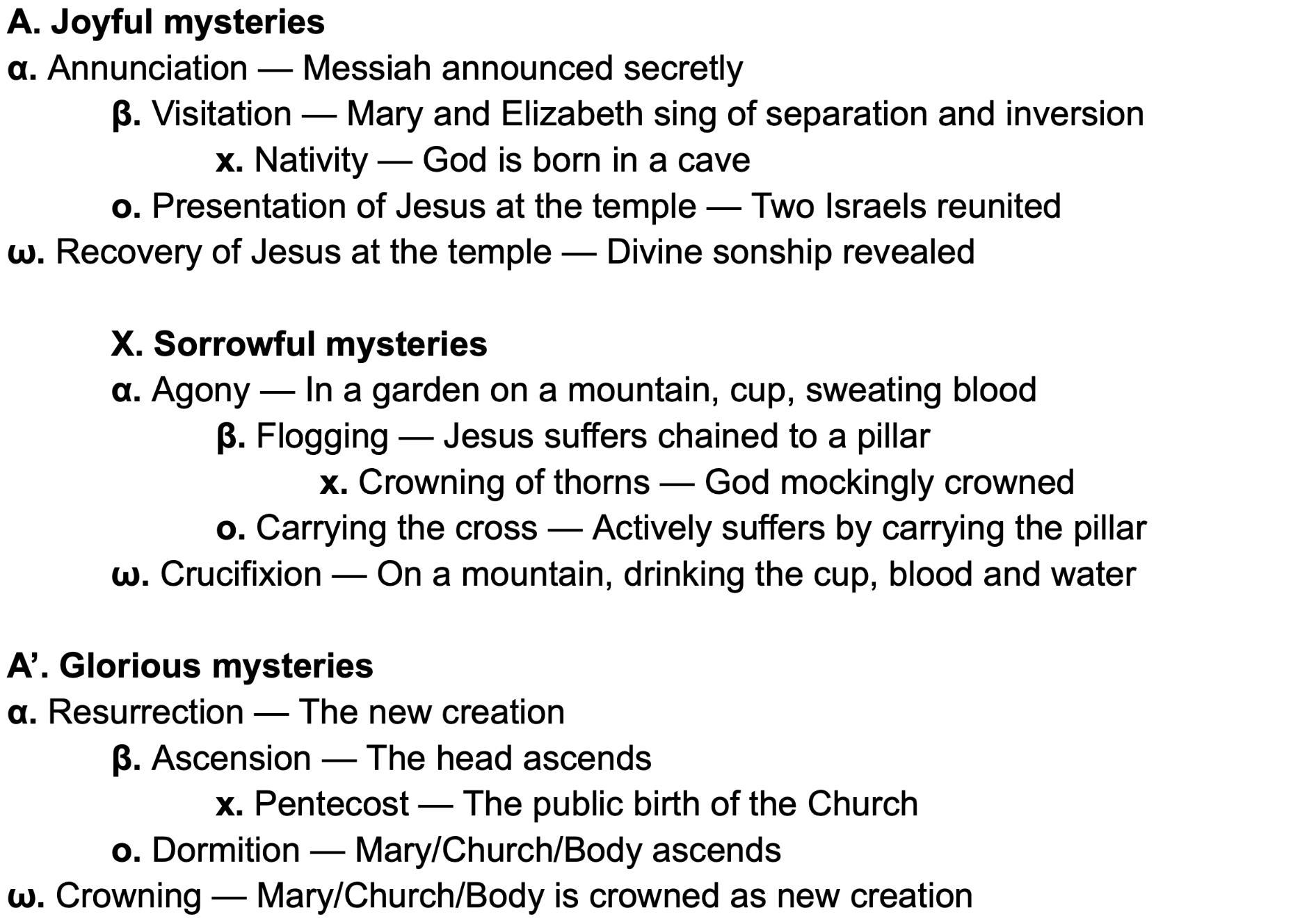
Presented as a linear sequence of 15,4 which makes the joyful-glorious parallelism clearer:

Praying the Chapelet
If one prays one chapelet at a time (five sets of ten Hail Marys, through five mysteries), then the most obvious chiastic structure one sees is the one that exists within each set of mysteries. Let’s start breaking this down from the center of the chiasmus: sorrowful mysteries.

The sorrowful mysteries constitute a fairly classic chiasmus, centered around Christ’s ironic crowning (x) as king of the Jews by Roman soldiers. Of course, we all know that this ironic crowning turned out to be true. The crown of thorns was a real crown, and the King of kings does judge all of creation on the Cross.
The Agony fits the typical α typology of Genesis by taking place in a garden and evoking elements that will only be fulfilled at the end of the story (ω), namely drinking the cup and sweating blood, wishing to avoid suffering. Importantly, unlike Adam who failed to accept suffering in the Garden, Jesus does accept. Then, the flogging in β represents a sorrow that is externally driven, with Jesus being chained to a pillar and passively suffering. After the x, Jesus will be actively united to his suffering, carrying his own cross (ο). This same idea will be carried to the end of the chiasmus (ω), where he voluntarily drinks the cup.
Next, let us turn to the joyful mysteries, centered on the birth of God in the flesh.

This chiasmus is centered on Christ’s Nativity (x), the surprise of the Most High God being born in a humble manger, in a cave. It starts (α) with an angel who tests the virgin Mary, like Eve in Genesis, and she passes, unlike Eve. The Angel prophecies that she will give birth to the son of the most high, that he will reign over Jacob’s descendants and his kingdom will never end. Further adding to the Genesis symbolism typical of α typology, the imagery of the spirit hovering over the waters of Genesis 1 is used to describe the conception of the Messiah in Mary’s womb.
The prophecy will ultimately be fulfilled later, in the glorious mysteries, but the ω part of the chiasmus already points to it eschatologically. After the 12-year-old Jesus goes to Jerusalem with his earthly parents for Passover, he goes missing for three days, to be found at the temple where he reveals his divine sonship (“did you not know that I must be in my Father’s house?” [Luke 1:49]) and is reordering creation by his questions and answers to the teachers at the temple. For those who meditate those things in their heart like Mary, Jesus is pointing to the fulfillment of the promise made by the angel Gabriel.
In the β part, the separation that happens is that Mary is “blessed among women”, as we said when discussing the visitation part of the Hail Mary. In that prayer, the visitation was the chiastic center, but compared with the Nativity itself, which is the greater reversal, the visitation becomes the β part, stressing the separation. Especially relevant is that while Zechariah — high priest at the temple — is mute, his wife and her cousin, in the hill country of Judah, witness the beginnings of the true temple — Jesus — which is separated from the Jerusalem temple at that point.
Then, on the other side of the chiasmus, in the ο part, the separation is mended. Jesus is presented at the temple. Further, two prophets, Anna and Simeon from the separated north and south kingdoms respectively, are reunited around Christ.5
Lastly, let’s go over the glorious mysteries.

This chiasmus is centered on the birth of the Church, i.e., Pentecost (x), the day when the confused and fearful apostles received the Holy Spirit and started confidently preaching the Gospel to the assembled Jewish diaspora. Around that center, we see clear parallels between the α part, where Jesus resurrects with his glorious body, the new creation, and ω, where Mary is crowned in heaven, representing the Church as a whole as the crowned, new creation.
Similarly, while in the β part, we saw Jesus’ Ascension as the head of the body ascending to heaven, in the ο part, we see Mary, representing the Church, ascending to heaven, with the Head.
Praying the full Rosary
If one prays the full sequence of 15 mysteries in one continuous prayer, especially after a few times, then the larger chiasmus encompassing all mysteries comes into clearer focus. I in fact noticed this shape about a year ago when, for the third or fourth time in my life, I prayed the full sequence to celebrate Mary’s month in May. Not only do joy and glory mirror each other around sorrow, but the mirroring goes all the way down to individual mysteries. I’m not the first one to notice, by the way.6
The sequence is the same as the three sets of five explained earlier, but showing them linearly makes the wider chiasmus more obvious.
The central X part remains unchanged, i.e., the chiastically arranged sorrowful mysteries, as we saw earlier. However, the beautiful surprise is that the joyful and glorious mysteries mirror each other.
Start with the Annunciation (A) and Mary’s Crowning (A’) in heaven. At the beginning of the story, heaven comes down through a holy angel to test Mary and begin the new creation. At that point, Mary is an unknown Jewish woman, barely removed from girlhood, who humbly and faithfully accepts, passing the test that Eve had failed in the Garden. In contrast, at the end of the story, she is the queen of heaven.
Next, during the Visitation (B), Mary is the new ark, containing the full presence of God on earth, and she ascends to the high country of Judah to go see her cousin Saint Elizabeth and her husband the high priest Zechariah. In contrast, in the Dormition (B’), the new ark ascends all the way to heaven.
Next, Nativity (C) and Pentecost (C’) mirror each other by being the birth of God in the flesh and the birth of God’s body, the Church. Note further that while the Nativity was announced to just a few select people by angels, at Pentecost the apostles are the messengers, and they proclaim the Gospel much more publicly.
Then, the Presentation (D) and Ascension (D’) both take place after a period of 40 days. Forty days after his birth in the flesh, Jesus goes to the temple, and similarly 40 days after birthing the new creation, he goes to the Father, in heaven. Also note that while two prophets, namely Anna and Simeon, proclaim the end of Israel’s wait for the messiah during the Presentation, at the Ascension, two angels prophesy that Jesus will come back (“‘Men of Galilee,’ they said, ‘why do you stand here looking into the sky? This same Jesus, who has been taken from you into heaven, will come back in the same way you have seen him go into heaven.’” [Acts 1:11]).
Finally, while the Presentation of Jesus at the temple was in a sense the end of the old priesthood and the promise of the new one in Christ, at the Ascension Jesus explains that the disciples will be ordained by the Spirit (“But you will receive power when the Holy Spirit comes on you; and you will be my witnesses in Jerusalem, and in all Judea and Samaria, and to the ends of the earth” [Luke 1:8]).
Lastly, the Recovery of Jesus at the temple (E) mirrors Jesus’ Resurrection (E’). Both take place after Passover and an absence of three days. And while Jesus’ divine origin was still obscure at the temple when he was twelve, that origin became clear after the Resurrection.
Weekly structure
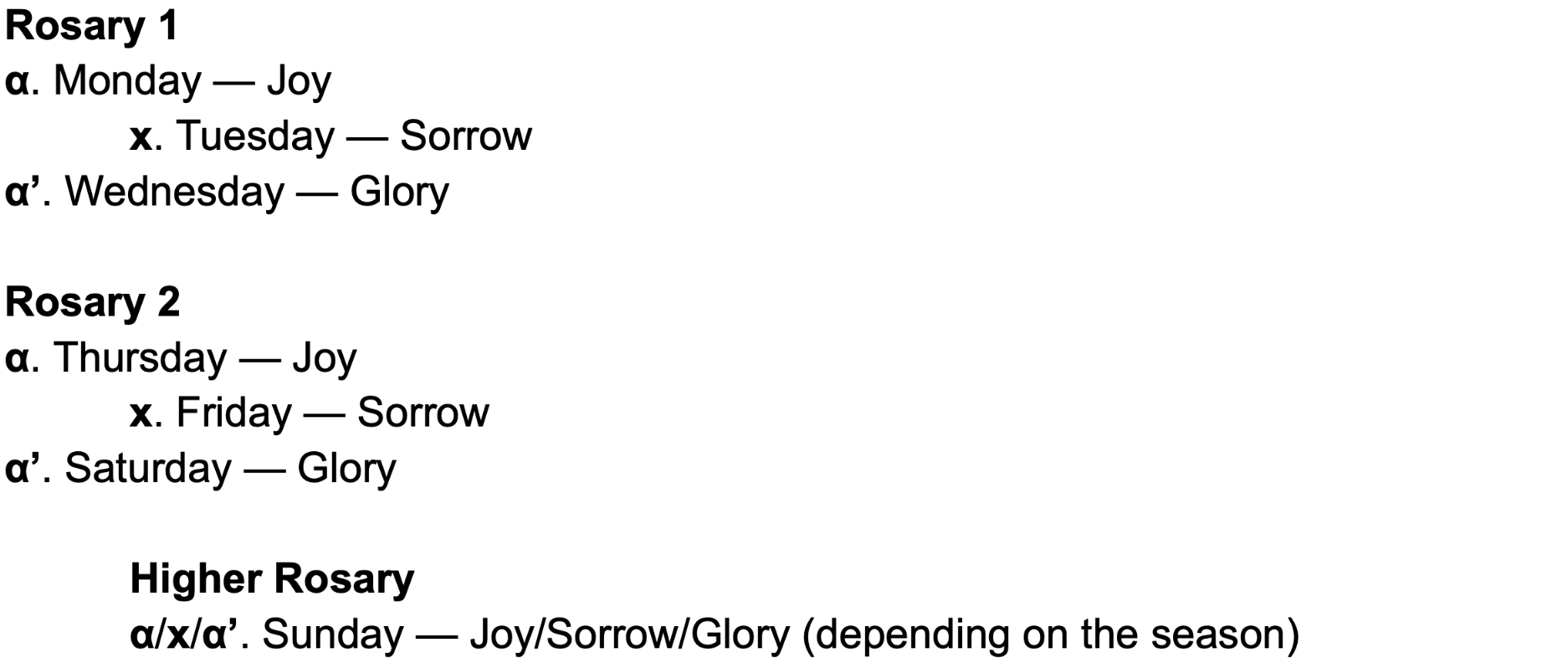
If one prays all three sets of mysteries everyday, then there is obviously no weekly structure to speak of. For the majority of Catholics who used to pray only one traditional Chapelet per day, however (before, that is, the introduction of the luminous mysteries), the weekly structure was interesting.7 The three Chapelets of the Rosary were spread over three days, repeating twice during the week, Monday through Saturday. Sunday would ingeniously stand at a higher level, following liturgical seasons: joyful in Advent and Christmastide, sorrowful in Lent, and glorious in Eastertide and Ordinary time.
The result is that one would go through two full chiasmi per week, Monday through Saturday, and that Sunday itself, at a higher level, would form a chiasmus around Lent. This isn’t exactly the purification-illumination-perfection triad,8 to which we’ll get later, but it’s close. The week is experienced as a pilgrimage, where one goes through the chiastic story of Mary and Jesus at increasing levels of participation, leading up to Sunday, that it is itself fractally a chiastic pilgrimage through the liturgical year.
Participation
Let me conclude with another way to contemplate the Hail Mary. I think that especially if one prays the full Rosary in one day (150 Hail Marys), the prayer is readily perceived, wave after wave, as the closing triad of the Octave,9 meant to help the faithful enter into the contemplated mysteries from purification, to illumination and finally perfection.

Indeed, we begin with the Annunciation (ς), when humble Mary is tested by the angel and found pure. We then move to the Visitation (ζ), when Saint Elizabeth perceives that Mary carries the messiah hidden in her womb. We finish (η) by asking intercession for ourselves, sinners, as we recognize Mary in all her eschatological glory as the mother of God.
The result, when one prays Hail Mary after Hail Mary, decade after decade, Chapelet after Chapelet, is an intuitive and felt participation in the same purification-illumination-perfection triad that Mary opened for us. Mary, our mother, becomes all the more glorious the more we, her children, enter into her glorious story.
Linked Articles & Posts
Linked Premium Articles & Posts
1. I also suspect that the desire to include a series of events from Jesus’ ministry, in the form of the luminous mysteries, was probably exacerbated in our age of widespread literacy, where we want to include all facts. In other words, not only did widespread literacy make chiastic structures less necessary for memorization and transmission, but it probably also made exhaustivity of historical events more attractive.
2. In French, we even use the word “entrailles” (“entrails”) rather than “ventre” (“womb”), which makes the inversion even more salient.
3. In practice, one would silently bring to mind the mystery and contemplate it for a moment before reciting the Hail Marys, keeping the mystery in the back of one's mind.
4. See Daniel Spiotta, “A Chiastic Presentation of the Mysteries of the Rosary,” at https://www.getprinciples.com/wp-content/uploads/2024/02/Rosary-Chiasm-Chart.pdf.
5. Anna is stated to be part of the tribe of Asher in Luke 2:36, while Simeon was a Levite serving at the temple, as stated in Luke 2:27.
6. Ibid.
7. Since Saint JPII introduced the luminous mysteries on Thursday, moved Thursday’s joyful mysteries to Saturday and solidified Sunday as glorious only, I can discern no particular weekly structure.
8. For an introduction to the Octave, see Cormac Jones, “Reuniting time and eternity via the Christian week as revealed in the Octoechos”, Substack, Jan. 24, 2024.
9. Ibid.



Comments