



Part I: Becoming who we are
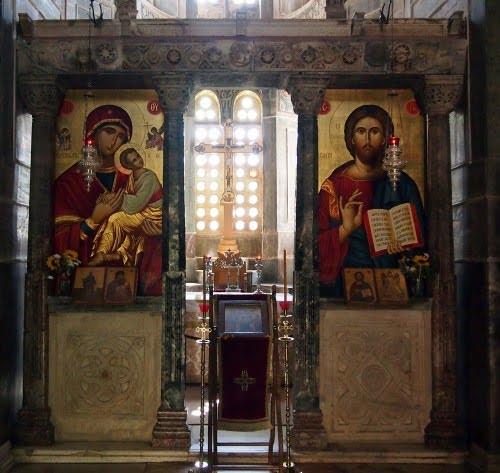
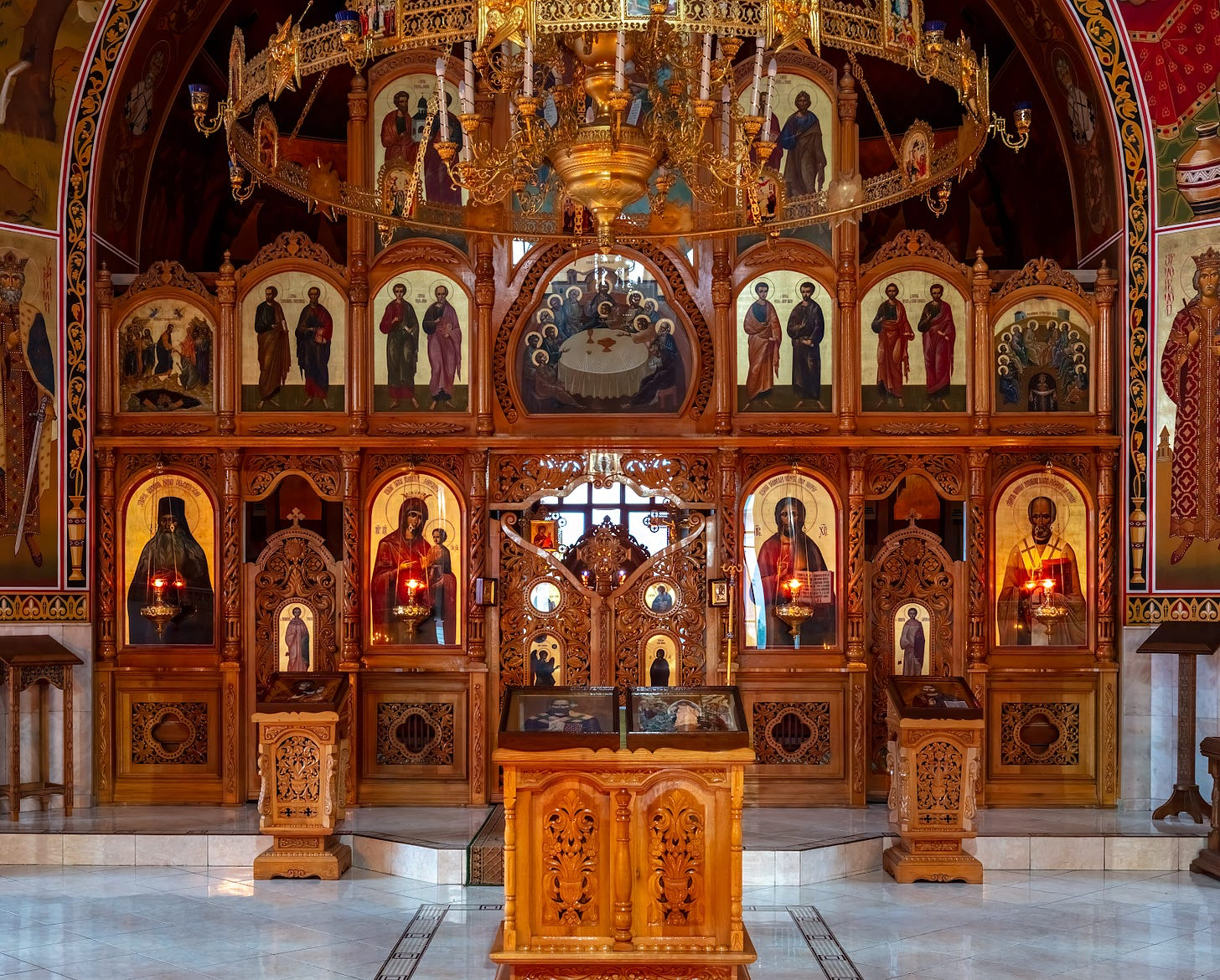
For Orthodox worship, even in the most makeshift of temporary worship spaces, every effort will be made to provide an image of Christ holding a book, which is always on the right, and an image of the Holy Mother of God holding the infant Christ, which is always on the left. These are permanently installed in a wall of holy images that separates the altar area from the nave, called the iconostasis. In an Orthodox church, the clergy (and only the clergy) enter the place of sacrifice through the Royal Doors which are between these two central images and directly in front of the altar. To an Orthodox Christian, no space will feel like a church without these images.
SCANDAL OF THE INCARNATION
Are we scandalized by the juxtaposition of Christ and His mother on what appears to be an equal plane? Why isn’t Christ shown to be above His mother? Even if we admit the use of images in worship (which is a discussion outside the scope of this essay), why should our central focus of worship require two adjacent images of Christ, one as a child in the arms of His mother and one as an adult? One might assume that is due to a folksy redundancy, or just an unthoughtful exuberance. But I will present that the layout is deeply intentional and speaks to the importance of both sexes.
THEOSIS
Firstly, the dual images of the iconostasis in an Orthodox church might be misunderstood by a casual visitor without an understanding of the Orthodox doctrine of theosis, which holds the Incarnation is not merely meant to transform us into better versions of ourselves, but to make us “partakers of the divine nature” (2 Peter 1:4). Mary is presented to us as that human being who was first united to Christ and transformed by grace. Just as God’s grace brought Christ down to us, only by grace does Mary have any place by Christ’s side.
OPPOSITES
The Orthodox iconostasis is a visual presentation of the Incarnation and how it might transform both men and women toward becoming partakers of the divine nature, not through the destruction, abdication, or denial of individual sex differences, but through living them out fully in God’s grace. And by that grace and only when a man or woman has totally and fully lived out their masculinity or femininity might they have a chance of that transcendence of our sex mentioned in Galatians 3:28, “In Christ there is neither male nor female.” Through Christ women acquire masculine strength that isn’t just pugnacious cosplay, and through Christ men acquire real feminine tenderness that isn’t just playing the victim, weakness, or dereliction of duty.
Both men and women were made good and according to the image of God (cf. Genesis 1:27). The feminine shows forth God’s tender mercy and the masculine shows forth God’s justice and strength. Neither men nor women are limited to these expressions only but they cannot deny them or escape them without doing violence to their natures, both body and soul.
DISSATISFACTION WITH OUR NATURES
In our age we struggle, feeling ourselves dissatisfied with our bodies and our sex. We attempt surgeries and use drugs, hoping to re-create within ourselves a new and better version of us, one that is more like the opposite sex or even like animals, anything to escape what seems like unfair prisons of our given natures. The layout of the iconostasis suggests reconciliation of opposites not just in themselves but the creation of a lasting and fruitful peace between the sexes: “Mercy and truth have met together; Righteousness and peace have kissed” (Psalm 85:10).
Just as sleep makes for more fruitful waking hours, rigorous work lends itself to good sleep: mercy and justice are both necessary. Distance can actually create great desire for closeness.
PILLARS THAT HOLD UP THE DOOR TO HEAVEN
Clearly, both sides are good, necessary and needful. Each side is a pillar. The right side represents God’s great condescension in a downward movement and the left side represents God’s great uplifting, an upward movement. Both are through God’s grace.
THE NEW EVE
Christ is often referenced as He who has come to reverse the sins of Adam (see 1 Corinthians 15:22, 45; Romans 5:14–19). He is even called the last Adam (1 Corinthians 15:45). This suggests the possibility of a last Eve as well, which the Church identifies as Mary, that woman who in the words of Christ is “blessed” not just because she gave birth to Him or nursed Him at her breast but because, as Christ Himself declares, she is the one who “hears the word of God and keeps it” (cf. Luke 11:27–28).
The first Eve of Genesis (2:18–22) was born from the side of Adam to be “an help meet for him.” And the new Adam is born from the new Eve. The Church portrays this new Eve in the temple as opposite Christ, notably not opposite St. Joseph, as is the case in some Roman Catholic churches. The Orthodox Church sees Mary’s marriage to St. Joseph as vastly less important than her relationship to Christ. For the Orthodox, Mary, the mother of God, is the “container of the uncontainable” as she is called in the title of this famous 14th-century mosaic from the Chora Church in Constantinople, “chora tou achoretou” (literally, “space for the spaceless”).

BREAK WITH PAGANISM
In a profound break with all previous pagan stories of gods and goddesses ravishing poor humans, Christ did not come to earth to seduce a human woman the way that Zeus might, but instead, in this new story, God becomes not the rapist of a human woman, but a woman’s tiny, helpless, utterly dependent, unborn child — and not against her will but by her permission: “Let it be done unto me according to your word” (Luke 1:38). And so Christ finally sidelines the pagan preoccupation with fertility and sexual power dynamics, but at the same time mysteriously retains the deep importance of sexual difference. Now all of creation will experience God’s voluntary subjection to a human woman, one of His own creation.
CHRIST AND THE BOOK
In the icon on our right is a man: Christ, He is faced squarely and confidently at the viewer and gives a blessing with His right hand while holding an ornate book in His left. What is this book? It is both a reference to Himself, the Word or Logos (John 1:14), but also suggests the book of life from Revelation (20:12) where the deeds of each are recorded, as well as the gospels which tell His story. The icon of Christ is an image of God who voluntarily takes on flesh, and writes the book of His earthly deeds. The book is at the same time the Scriptures, or the story of His life, and also a symbol of Himself as the word or truth; He is a conquering hero, holding the book of Himself.
MARY AND HER SON
The icon on the left is a woman, Mary, the mother of God. She is portrayed holding an infant, her son, the Christ, who is blessing the viewer with His right hand. She is turned slightly, so that only one eye is on the viewer and the other eye is slightly tilted away. She’s slightly hidden, modest, and usually in many layers of robes with not even her hair showing. She gestures toward Christ or caresses Him. She’s a human who has taken God into her own body, voluntarily writing the book of her life with her own flesh; in the absence of a human father it was her flesh that became the body of Christ, who is the Word.
BOTH SEXES ARE BLESSINGS, AS ARE CHILDREN
And so, though she holds the Child and He the Book, they both hold the same thing: Christ the Word. On the right, Christ the adult gives the faithful a blessing, on the left Christ the child blesses the faithful as well. The Church presents these images to us equal in size and significance, suggesting through art that both women and men not only are blessed, but also bless us; illustrating how children (as represented by the Christ child) and adults are of equal worth in the eyes of God, which is why even infants are baptized and receive holy communion in the Orthodox Church right along with the adults.
HUMILITY AS GLORY
God blesses us through the beauty of independent masculine strength on the right, and God also blesses us through the beauty of feminine multiplicity, holy dependency, and cooperation on the left. The hierarchies remain but are shown to be transformed from pure power dynamics into ways that love and honor may flow. As St. Paul says,
“In your relationships with one another, have the same mindset as Christ Jesus: who, existing in the form of God, did not consider equality with God a thing to be grasped, but rather, He made himself nothing by taking the very nature of a servant, being made in human likeness” (Philippians 2:5–7).
Here we see that equality is achieved through humble obedience to God’s will for both sexes. Christ is the suffering servant from Isaiah 53, “a worm and no man” (Psalm 21[22]:6); and she is the one who rejoices in her Savior for “regarding the low estate of His handmaiden,” she whom “henceforth all generations shall call blessed” (cf. Luke 1:48).
THE MAN IS EMPTIED AND THE WOMAN IS FILLED
In earthly life, Christ the God-man “emptied himself, taking on the form of a slave” (Philippians 2:7), pouring out His strength and great deeds. Conversely, Mary the blessed handmaiden (Luke 1:48) finds God in allowing herself to be filled, first with the baby in her womb, and then with milk, for His nurturance — filled even with memories of her child, treasures of the works and words of Christ, “pondering them in her heart” (Luke 2:19). And finally, she allows her grown and dead Son, taken down from the cross, to fill her lap like a ripe fruit, a great harvest.
SWORDS, LITERAL AND METAPHORICAL
We are told it was said of her in the Scriptures, “a sword will pierce your soul” (Luke 2:35), and so, as the sword that pierced Christ was in his flesh, the sword that pierced the mother of God was in her soul. And this is true of all women, being made more emotionally fragile by God for important reasons having to do with her nurturing role, it is in her emotions that a woman suffers the most. And it is men who are called to be crucified in the flesh for sometimes ungrateful brides (cf. Ephesians 5:25ff). God honored the man by becoming a man Himself. God honored the woman by not only submitting to her will in that great desire of His, but by uniting to her flesh, while her body became His throne and tabernacle.
NECESSITY OF BOTH SEXES
Because both our masculinity and femininity are from God and are images of Him, if men ever hope to have union with God, they cannot retreat from or block out the feminine from his life, any more than a woman can hate and avoid the masculine and hope to find salvation.
While not every woman becomes a physical mother, every single person on earth has a physical mother. And a woman’s decision to nurture her child — or any person placed in her care — will be the most impactful decision each person ever experiences. A woman’s choices regarding those in her care mean life or death, health or illness, emotional well-being or disintegration, for each person on the planet and not just as infants but their whole life and especially at the end.
THE GREAT POWER OF MOTHERS
While women only compare themselves to men of their own generation or older, they are likely to feel less powerful, but when they carefully examine the great power they have over their infants and children, they might realize the power differential between a mother and her unborn child or infant dwarfs any power dynamic a man will ever have over a woman. The power of a woman over her own infant is the closest any human comes to God-like power over another human being.
The decision to become a mother is the decision to allow someone else to take the place of the weakest and most important person in the room. To become a mother requires no striving, at least not at first, during pregnancy. After the initial consent, if women simply do nothing to stop nature, a new human will be made, this is why we associate the feminine with a divine passivity or receptivity. That is not to say women and mothers are perpetually passive and never active toward people, the best wives and mothers are always very busy. But it is the being which is primary; it is who a woman is to her family, which affects the child and everyone so deeply.
PRIVATE WORLD OF MOTHERS
Most of the greatest works of females, including gestation, are secret, and even after the birth of a child, the continued work is quiet, hidden from the world, not public or showy or overt. Attempts by some women to make their raising of children a public affair, such as through social media, reality shows, etc., are hurtful disasters. People are starting to realize how dangerous this is and unfair to the children.
UNION OF THE OPPOSITES
And so Orthodox Christians worship God in a temple between two images which create an aperture to heaven and suggest a fruitful union of opposites, like the marriage of the Bridegroom, Christ, with all of His creation. These two icons show, not the confused mixing of the opposites as suggested by pop culture’s obsession with gender bending, but the proper meeting of opposites which create a space for worship and lead to the altar. As we pray, imaged before us on our left and right are:
femininity and masculinity
multiplicity and unity
mercy and justice
earth and heaven
darkness and light
rest and work
nurturing and discipline
sleep and awake
the unconscious and the conscious
tenderness and strength
sensitivity and toughness
responsiveness and holy dispassion
chaos and order
what could be and what is
the hidden and the revealed
being and doing
the holy yes and the holy no
emphasizing the process vs. emphasizing the goal
unconditional love vs. love which makes rightly ordered requirements
receptivity vs. hard boundaries
togetherness vs. independence
communal relationship vs. individual striving
and many more…
This is part of why it is so very satisfying to worship in an Orthodox space because the temple itself indicates what we do there: all of creation is recognized as good and offered to God and nothing is left out, everything is in its place and rightly ordered so that the soul is at peace there.
Part II: Becoming in grace what the opposite sex is in nature
UNEQUAL, EQUAL CONTRIBUTIONS
Men strive to achieve something in the public world, in response to the mostly female miracle of gestation, birth, lactation and nurturing of their children. Their inadequacy and inequality before that mystery of life pushes men to achieve what might come close to rivaling the creation of another unique human being. Finding their contribution to this miracle strangely trivial to the process of human gestation, men seek to push themselves to create a safe, ordered and beautiful world appropriate for these new, small and vulnerable people and their mothers, and this becomes civilization. The more men achieve in the world, the closer they come to an equivalent contribution to human life as their female mates; which is just as much a miracle, requiring nothing less than it does of the mothers, for both women and men give their energy and sometimes even their lives to the making and care of both the human body and the human world.
In our iconostasis, Mary holds Christ and Christ holds Himself: the Word. Here we have a vibrant double image held up before us of unity and multiplicity, independence and tender communion. The female saints were not only feminine, they were balanced with a dose of the masculine as well. The celibate desert mothers were likened to lions. Male saints are not only masculine, but blessed with the best of feminine characteristics. The holiest are well-integrated people able to be as well as to do; to nurture as well as to conquer.
HOLY INVERSION
The right side has always symbolically been the place of order and stability (the masculine) and the left the place of chaos and potential (the feminine). However, because the images of the iconostasis are not fixed up against an exterior wall, but always occupy a middle space in the center of the church making a doorway to the altar, when the priest turns to face the congregation, when the priest is inside the altar facing the people, the image of the Virgin Mother will then be on his right and the image of Christ will be on his left. This is a reminder of the inversion that happens for men and women who embrace the depths of what it means to be a man or woman. The altar is symbolically heaven, and from that perspective, holiness, or union with God, will invert the perspective, and the woman will now be on the right and the man on the left. A holy woman embodies the best of male attributes; the holy man embodies the best of female attributes, but neither sex does this through deception, disfigurement or dismemberment, but rather through theosis: union with God through His grace.
THE REAL TRANS
Christ in his Transfiguration (found in Matthew 17:2) and His Resurrection (Luke 24) shows us that our bodies are not insignificant to our mission in life: they are not just a husk to be shed. Our bodies prophesy to us everything of who we are, and they point toward an end for us. Modern people have rejected the idea that our bodies can tell us anything of who we should be, and that has left us very confused.
Many modern feminists reject Mary, the mother of God, as simply not that interesting mostly because these same people have elevated the public over the private, the commercial over the free gift, independence over connection, doing over being, the individual over communion, the overt over the mysterious. Feminism has often chosen male bodies, the male perspective and approaches, to be preeminent and most human and something for women to imitate, often putting down their own sex and its unique contributions.
COMPLEMENTARITY
Each sex has strengths and weaknesses that complement the other. So those ordained to be the carriers of infants also have the nature that tends to want to stay in the lines established by society. And those who have danger in their blood are men that face outward toward the world establishing order and keeping evil at bay to create a nest for children. But there is adventure in both.
BOTH FIGHT IN THEIR OWN WAY
Traditionally, men and women were like ancient warrior friends fighting together back to back against death and sin, circling the home fires, where the very young, the very old, the sick and needy are kept safe. He fights outward against the onslaughts of nature and the evils of the world, and she fights entropy, disease, and moral degradation in the children and the weak and sick in the private space of the home.
While the moral challenges that men face are more apparent, it is not always so obvious to women that there might be a serious and equal challenge raising a young family. Young women facing life as a homemaker are often surprised to find how hard it is, which can frighten her right back into the workplace because there she can contend with forces of life that are bigger than herself and be the underdog in her own story. But caring for small children, a woman will be faced with her own terrifying power. To hold an infant is to look into the abyss and find a small mirror, reflecting back a surprise that she, the mother, is not the angel she suspected herself to be. Compared to an infant, a mother has god-like powers.
POWER OF WOMEN
Commonly a woman does not realize her own power before the moment she is faced with the vulnerabilities of her infant. Her experience was, up to that point, usually thinking of herself as the weaker party compared to her parents, the world, her co-workers, men, and suddenly now she has all the power in the world, like a giantess from a fairy tale, nearly infinite compared to this weak, tiny thing, so dependent on her. Merely one word from her and the tiny creature could be crushed. Or if she only does nothing for it, the child will die. That is great power: to destroy another person, all at once or a little at a time through torture or simple neglect.
ICONOSTASIS IS NOT OPPRESSION
Do not misunderstand the iconostasis. In the best of times men will hold babies, just as surely as women shall write books. For any business to work effectively, having the right people with the right strength, skills, and temperament to do what is asked of them is essential. But, there’s a reason accountants and artists are usually very different types of people. We are currently making a large scale social experiment with the roles of men and women.
CHAOTIC BOOKKEEPING AND TERRIBLE ART
Imagine if we decided to put intense social pressure on all accountants to be artists and all artists to be accountants. In this case, we only have the serious negative outcomes of chaotic bookkeeping and terrible art. When it comes to children and creating a world for them, we cannot afford such experiments. We have natures. Whether we want to attribute that to the work of God or an evolutionary system, we cannot simply declare women singular beings after they have been for so long plural beings (with their children and those they care for) and assume we will suffer no great loss.
CONCENTRIC CIRCLES
If we return to the image of the concentric circles with a child at the center, the mother in the next circle out, nurturing the child in her body, and the father in the circle after, facing the world beyond, protecting and providing: we see that it is the strong connection between the mother and father that is the way a child can thoughtfully enter into the world. If the relationship between parents breaks down, a child will find it hard to become an adult because the link to the world outside the family through the father is gone.
Children need both a nurturing, unconditional love: “I love you just as you are,” and a nurturing conditional love: “I know you have the potential to become more than you are.” While true mothers can and do say, “I think you can do better,” and fathers can and should say, “I love you just as you are,” women embody unconditional love (or mercy) because without unconditional love the infant will simply die. Men embody beneficial conditional love (or justice) through their boundary-imposing strength. Both are absolutely necessary.
CONDITIONAL LOVE IS INAPPROPRIATE FOR INFANTS
Conditional love is not proper for infants. They simply cannot survive that sort of pressure. Under about nine months, they are in the phase of simply existing and being always right. The bedrock of unconditional love offered from the mother allows the child to experience the more conditional sort of love they will encounter later, not as unkind tyranny, but as a fostering care that aspires to exciting growth, instead of disappointment and depression.
The sensitivity of women was given to keep infants and the vulnerable alive. She provides the voice for the voiceless. When we value both sexes, we put the sensitivity to work where it works best and save the insensitivity for the battlefield, the butcher shop, dissecting table, or wherever it is most helpful, rather than attempt to create sensitivities where they don’t exist (such as having men care for infants full time), or brutally force insensitivity on the sensitive (such as placing females in frontline combat).
Our church has placed before us the iconostasis: the image of the sexes; just as in our physical homes we usually grow up between a woman and a man, between nature and nurture, between mercy and justice, accepting love and challenging love; thus each Orthodox Church and every Divine Liturgy, God comes down to us in the space between a man and a woman.
PUT NOT YOUR TRUST IN PRINCES AND SONS OF MEN (PSALM 145[146]:3)
The iconostasis teaches us that true equality is not found by others giving us promises or from escaping the realities of our individual sex or demonizing or avoiding the opposite sex, but from implementing what it means to be a man or woman. Christian equality between the sexes is found, like water finding its own level, in humility. Each sex will truly meet, see and know the other only in an imitation of the humble obedience of Christ and His mother.
To become Holy is to acquire those good things which we do not naturally possess, to transcend sexuality, not in grotesque surgeries or exaggerated acting, but by becoming through grace what the opposite sex is by nature.
BECOMING BY GRACE
These two images of the iconostasis are quite purposeful and are meant to present us with great holiness in multiplicity. There is indeed a great blessing in living out either of the two fundamental ways we encounter the world: male or female. It is no mistake that our highest moment of worship and union with God, in our place of worship (where we are “born again“ John 3:3), should also take place between a representative of each sex.
It is no wonder that we writhe under the weight of the holy and unbearable task of being a man or being a woman! But it is foolish to envy or be ungrateful for God’s provision. One cannot leave one’s post at the altar of the Lord and seek to hold up the other side, leaving their door post to the gate of heaven unsupported. The iconostasis teaches us that when we each take our place at the left or the right, humbly taking our cues from the bodies God gave us, as men and women, we participate in an aperture to heaven, the holy doors of the altar.
What we admire about the opposite sex can be ours, not through our own grasping efforts but through transformation of grace as represented by the priest passing through the Holy Doors. When he turns to face the people, the man, Christ, is now on the left and the woman, Theotokos, is now on the right. Just so, it is only through theosis that we can hope God will supply for us through His Grace that which we lack by nature.
Katherine Hurl’s essays on masculine and feminine can be found at her Substack.
Comments