


.svg)

The Filmo Es el Tonto (por Cristo)


.svg.png)
How making an Orthodox Christian art film is like baptizing a mermaid

A note on movie spoilability
In our consumerist culture, we have had to establish rules and guidelines to protect the individual’s experience of consuming stories that are mostly disposable and good for one use only. Hence, spoiler tags. This is, generally speaking, not how human stories, constructed according to the shape of our cosmic reality, are supposed to work. That they commonly do is a symptom of our consumerism, of our self-centered, exploitative relationship with the world around us. But stories that are truly great can’t be spoiled. They have so much cosmic truth compressed inside their symbols that they can be returned to again and again for one’s entire lifetime. And so these great stories tend to be told with the expectation that they have been heard before, with attention being paid not to the revelation of an unknown plot for the sake of ephemeral pleasure, but to the contextual instantiation and embodiment of eternal patterns. There is still a great sense of discovery in the telling of these tales (when the telling’s done right), but it’s a discovery of the eternal, not of the ephemeral.
So great stories can’t be spoiled. And also, I maintain, bad stories, stories for instance that exploit the passions, can’t be spoiled. You can’t spoil something that’s already rotten. So is there any use for spoiler tags? Are there stories worth hearing that rely on, or at least make purposeful use of, the audience’s ignorance of the story going in? I think they’re a lot less common than our proliferation of spoiler tags would suggest, but yes, certainly, such stories exist. The act of withholding and then revealing pertinent information can be a cheap trick for the manufacturing of catharsis, but if one is aware of its cheapness and does not rely on it entirely, positive use can be made of it, yes. And artists in our day, communicating with an audience of junkies expecting ephemeral dopamine rushes from disposable stories often need to meet their audience’s expectations at least part of the way. The real trick they need to pull off then is to make positive use of spoiler-sensitive storytelling tactics, to help morph the audience’s appetite for discovery of the ephemeral into an appetite for discovery of the eternal. What results from such storytelling artistry is a kind of monstrous hybrid, but a purposeful one, like the transhuman creatures of myth, the centaur, the minotaur — or El Tonto por Cristo’s hybrid of choice, the mermaid.
Josh David Jordan’s movie El Tonto por Cristo takes such a hybrid form of story. It’s a movie absolutely worth watching, but also one that could benefit from a spoiler tag. Typical of the art film genre in which it’s operating, the movie largely disposes of exposition, and so the identity and relationship of the characters aren’t deliberately spelled out. Jordan makes a virtue of the uncertainty by using it to replicate the experience of meeting new people in an offline environment. He tempts the viewer to judge the characters before one knows their background and can understand their actions. Ignorance of the story upon first discovery can thus play an important aspect of the experience. Rewatches of the film play an important aspect, too, but then the purpose is to reframe the initial encounter, to drain the pleasure of ephemeral distraction and shift the viewer’s attention to the eternal edification contained therein — or, in the film’s language, to baptize the half-human, half-beast mermaid into the humanity and divinity of the hybrid Godman.
The aim of this essay, then, is to help people understand the film upon reconsideration of it. You can choose to read what I write here without watching the movie, but you will be depriving yourself of initially experiencing the movie while ignorant of it, like a kind of mermaid. For the artist in this case does make purposeful use of such ignorance.
El Tonto por Cristo is available to rent or purchase on Amazon and YouTube (or for purchase only on Apple TV). Visit the movie’s website here.
The movie teaches you how to watch it
“Be not as the horse or as the mule which have no understanding; whose jaws thou must hold with bit and bridle, lest they come nigh unto thee.” – Psalm 31:9
Art films are concerned with how we pay attention. In general the difference between art films and popular cinema is that art films deliberately require active attention on the part of the audience whereas popular cinema suppresses active attention and fosters passive attention instead. Popular cinema’s popularity depends on, formalistically, its ability to render passive a very large amount of people. Thus, for example, editing and close-ups will commonly be used to decide for the viewer what exactly they are supposed to be paying attention to at all times. A demonstrative music score will tell them exactly what they should be feeling, should the other cinematic elements ever fail to make this unambiguously clear. A large part of the entertainment’s pleasure, then, is having one’s attention possessed and manipulated by a dominant force. Such experiences can relieve stress and serve the purpose of renewal in the vein of sleep, if more powerful. Like any narcotic, in doses it can be useful in times of extreme duress. The potential for addiction, however, is hazardously abundant. It can be dangerous to use for recreation because the result of addiction is a type of enslavement and possession, even a kind of mind control.
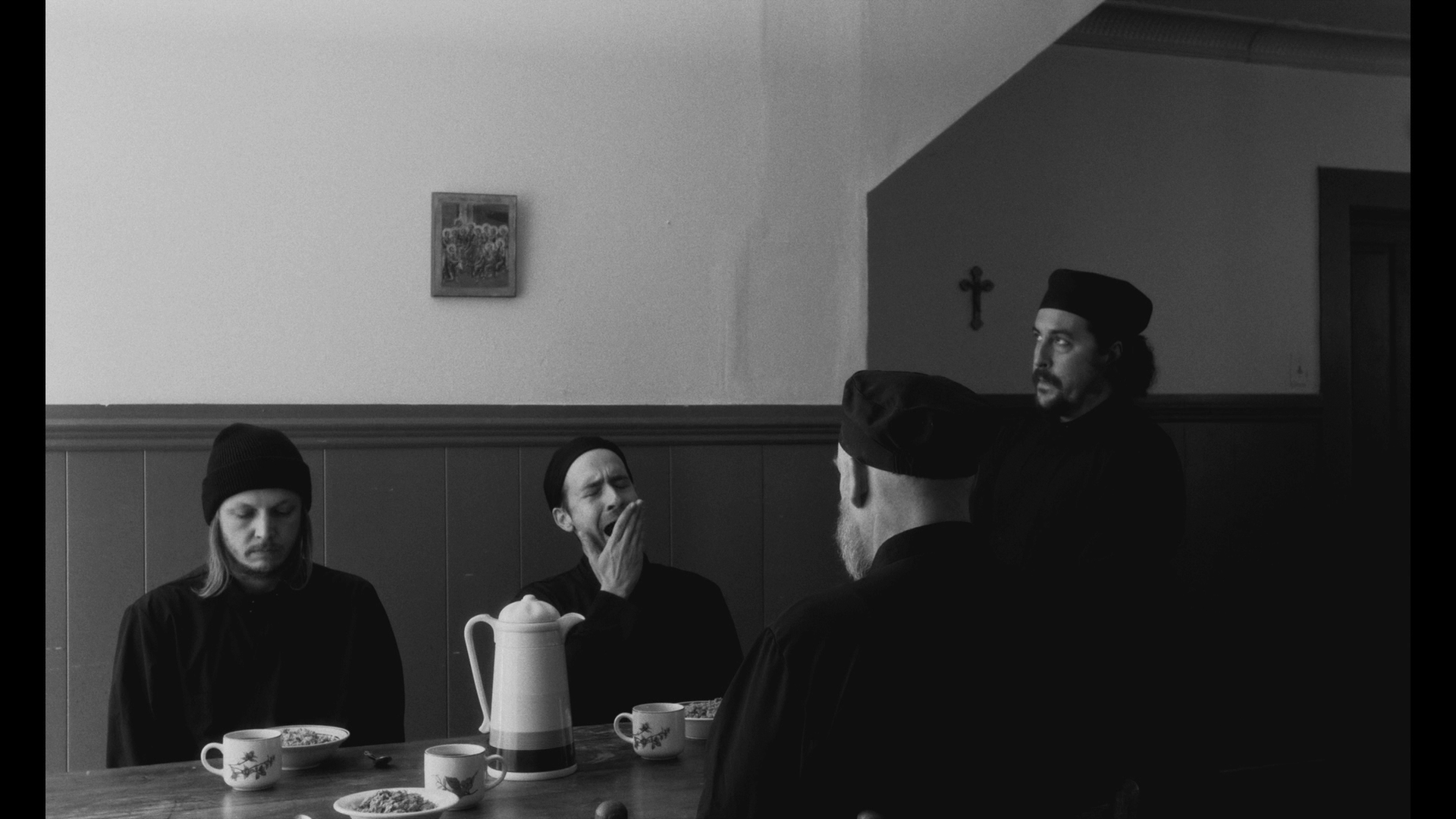
Art films can serve as a kind of methadone to help rehabilitate one’s ability to pay active attention and thus to think for oneself. Let’s consider the opening scenes of El Tonto por Cristo. In the trapeza (refectory), the monks are waiting silently for their abbot to come downstairs and bless the food so that they can eat. The scene is shown in wide shot, with multiple characters in one frame, so you are given a full plate of information to parse all at once. The director isn’t cutting with the camera from this character to that character to tell you forcefully what is occurring in the scene. The viewer instead is expected to look at the scene for oneself and read visual cues as to what is occurring. For editing isn’t used to direct the attention, but visual composition is. You’re just being asked to read it. It’s not a hard assignment. One monk on the right stands above the others, who are sitting, so he is visually more prominent in height. It is fair to assume then that he is the senior monk present. Central to the frame, though, is the face of a seated novice. His non-verbal reactions are accordingly the central focus of the scene. Since he’s a monastic we can expect him to be striving for patience and obedience, but we watch him fail miserably as he cannot suppress humorously rebellious gestures of impatience. His impatience, meanwhile, may mimic our own in the audience as we have sat down to be served a movie and are waiting for the meal of the story to begin. As we eventually witness the abbot mysteriously transport from one level of the house to another (depicted magically by a disruption in continuity editing), we are being shown by the storyteller that not only will patience be rewarded with an eruption of miraculous meaning, but even impatience will mercifully be rewarded no differently if we can just stick it out and remain present.

And in fact this second scene is already reinforcing what we were shown with the opening shot of the movie. It’s a long shot, nine minutes long, with no editing, just visual composition. And our field of vision is a literal field. Various monastics, viewed from a distance, are laboring in the field, laboring in hope of bearing fruit from the land, the same way we look out at the world and expect to reap meaning from it. From this wide shot full of general information, there gradually emerges a singular figure, full of anguish and joy and overwhelming emotion. He comes from afar and enters into close-up, filling our gaze. The long scene operates as a promise, and as a lesson in how to read the movie. If you sit up in your chair, as it were, and do the easy work of paying active attention to the field of images presented before you, great meaning will emerge — a reconnection to your humanity, perhaps, like a reunion between orphaned brothers.
You can see how the movie isn’t playing the dominant masculine role of popular cinema, forcefully dictating the meaning-making experience to a passive feminine audience. It’s rather playing a relatively more feminine role akin to nature itself, whereby the movie looks to you the audience to step up in a masculine way and actively find the potential meaning inside it. I don’t mean to suggest that one mode of filmmaking is inherently better than the other, but to those who have been overly feminized and moreover brutalized by an abusive masculine cinema that does not have your best interests in heart as a human being, but rather seeks to exploit you for either commercial or ideological reasons, watching a little art cinema of the right type (obviously art films can serve inhuman purposes as craftily as any abusive woman) can be remedial for the soul.
So in contrast to art cinema (or, it might be said, verbal storytelling, either oral or written, which invites the imagination actively to fill in all sensory information) popular cinema in its form fosters a docile audience, placing a harness on its head, a bit in its mouth, and blinkers on its eyes. But the Lord does not desire we be this way, and we know from the Scriptures, as well as from just plain nature, that He tells stories in a very different fashion. He doesn’t want us to be shackled and manipulated like a beast with no intelligence, prone to rebellion. He wants us to be like Him, sons and heirs to divinity, not prone to rebellion but lovingly obedient, for starters, and ultimately capable of bringing forth meaning both from the natural world prepared for us and from the symbolic stories about that world told more explicitly to us whose spiritual literacy has fallen from the heights we were originally provided. He wants those whom He has instructed in the kingdom of heaven to be as men that are householders, who bring forth out of their treasures things new and old (cf. Matt. 13:52). Old treasures, yes, like stories told by God from the beginning. But also new treasures, stories that are new, eternally new, love stories between heaven and earth, and between God and man.

Salvation for the mermaids
But we who are men — how are we to be Gods? Maybe as originally created, if we were preserved in pristine condition, we can almost imagine human beings suffering such divine nuptials. But we fallen men? We habitual sinners? Can there possibly be redemption for us? And not just redemption, but deification?! This question pertinent for all eras is shaped exactly like a more specific question happening in our time, not as statistically common as the internet might make you think, but certainly present and lived: how can Americans become Orthodox Christians? That’s the question El Tonto por Cristo is asking, and it compares the proposition to the unlikely baptism of a mermaid.
American identity begins when one is driven by trauma off one’s land and into the sea. The new land these Americans find to live on is but a metaphor for the reality of their transhuman fish lives in the ocean. Terribly beautiful, they seduce the world with their songs from the margins, with their gorgeous voices, and drive mad everyone who hears them. The world’s sailors commonly drown to death diving from their ships into the waters seeking the illusive promise of freedom of which the American mermaids sing. Beautiful, terrible, gorgeous, wicked... homicidal, genocidal, glorious — they are but the reflection from the margins of the central story of fallen mankind, the multicultural recapitulation of all the world’s peoples at world’s end, peoples who sought freedom in worshiping themselves and not God.
Yes, our Lord has redemption in store even for these. His mercy remains unconquered. So that’s the story Josh David Jordan sets out to tell in El Tonto por Cristo. We meet a small community of monks at an Orthodox monastery on the Gulf Coast of Texas in the mid-1980s as they strive for a peaceful existence with holiness. It is not easy for them. The novice Genesius, the impatient one central to the early trapeza scene, has a particularly difficult time. We discover his past profession was in the theater or circus as a mime or clown — a professional fool, a jester. Now, if a painter or a carpenter or a musician converts to the Orthodox faith, there are liturgical arts where obvious use can be made of one’s talents. These gifts given to them can be gifted back to God through His community, and these artists thereby can participate in holiness. Even a mathematician can help with the computus of Pascha; even accountants and lawyers can help with parish administration. But where does one gifted with pantomime fit in the Church? For certain not liturgically! The question parallels Josh David Jordan’s own as a filmmaker. Cinema, like the theatrical arts before it, is an inherently anti-liturgical art as far as the Church’s liturgy is concerned. I don’t mean that in a necessarily negative way. Before it means “against,” anti means “instead of” or “in place of.” It is clear from the American ritual of going to the movies on the weekend, that cinema plays an anti-liturgical role in the American secular religion. Even Abraham Lincoln famously one Holy Friday in April 1865 attended a play at a theater. How can any such religious practices, developed in apostasy from the Church, play a role in the Church’s life? Those who are gifted with talents in these arts — how can they return their gifts to God?
Do you see the mermaid analogy here? Contained in El Tonto is the story of Li Ban, a pagan princess in ancient Ireland whose father and whole family are drowned to death when overnight a spring bursts and forms Lough Neagh, the huge lake in Ulster (largest in the British Isles) that is named after her father. In the cataclysm this young maiden, along with her little dog, become trapped by the waters in a cavern underground, and so she and her dog alone survive. But she is trapped there for a year. After this year of despair transpires, some kind of deal is struck with this young princess of a nephilic people. She is transformed into a mermaid and allowed to haunt all the seas but to keep her residence in Lough Neagh. Her little dog is transformed into an otter and allowed to join her. For three hundred years she exists in this transhuman form, luring men to their deaths in the ocean with her beauty. But one day, in the sixth century, she encounters St. Comgall of Bangor off the coast of Ireland on his way to Rome. In this holy man she perceives someone that is different, someone over whom she has no power of seduction, and so her heart is drawn to him. They meet and talk. He is on his way to Rome, so they agree to meet again in a year’s time in an inlet on the coast of Ireland. This year of hope transpires, and Li Ban waits in the designated place. A moment of terror occurs when she is incidentally caught up in a fishing net by someone, but it turns out to be a monk who is known to St. Comgall. The holy man arrives, on his return from Rome, and the meeting occurs as planned. In the end Christian baptism is offered to the mermaid, and her heart accepts it. St. Comgall gives her baptism and renames her Muirgen, “born of the sea,” upon which the ancient spell is broken and she ceases to be a mermaid. She returns to her original human form and also rapidly ages according to her actual age. She is soon to repose in the radiance of illumination, but beforehand she reveals that at the time of her baptism she had the option of living on as a mermaid for another three hundred years. Her relics are gathered and treasured (argued over even, for these are Irishmen), and St. Muirgen’s name was placed in the Irish calendar of saints on January 27.
If such stories appear to be like fog wafting up from the periphery of Christian consciousness, it’s not unmeaningfully so. Nor is it unmeaningful to have hagiography operating in this space. The Lord is going to have mercy on more than just the headline saints in the Church calendar, the bishops and martyrs. Divinity according to Christianity not just emanates from the mountaintop of history, but also emerges from all the marginal cracks of creation. God is the light in the heavens amidst all the stars, and He is the infant in the cave rubbing up against animals. So what does it look like when the Lord has mercy on the most wretched of sinners occupying the dimmest underwater caverns of human experience? If Li Ban is not transformed into a mermaid, is she ever able to surface from her despair? Well, the Lord could have sent an angel to rescue this pagan girl who had never encountered Christ — but indeed He did; it was just an angel of the left hand instead of an angel of the right hand. All rebellious spirits, false principalities, demons, serve the Lord’s purposes involuntarily, and no one escapes His providence. As a mermaid, which is to say, as a demonized creature, Li Ban may herself have perpetrated many evil acts and lured many to death. But the Lord knows the horrendous trauma she endured in her youth, and His love and His mercy are much greater than any sin she committed in response. Why did the Lord allow the trauma in the first place, one may wonder? That’s not part of the story — medievals didn’t have to answer to modern atheism — but in a biblical context it’s not hard to imagine why a flood might happen. Maybe her people were demonically wicked. Maybe if the flood hadn’t happened, even worse trauma would have befallen Li Ban. In the end, St. Muirgen’s story testifies to the profound depths of the Lord’s mercy and power over all creation, and she herself is enshrined in the heavens among the saints for endless ages. That alone is enough to justify the Lord allowing rebellious creatures to work all the evil that they did.
So, speaking of rebellious creatures, what again is the role of the Americas in the one, holy, catholic, and apostolic Church? It’s like the role of a filmmaker, or of a story about baptizing a mermaid — or of a jester. It is the power of renewal that comes from the margins. Think of humorist Mark Twain; he epitomizes this facet of American culture, this use of satirical wit to expose abuses of power. The Americas are a place of rebellion. It’s where rebels go, and it’s where rebels stay to see it through to the end, to see the consequences of their rebellion. As a result there is a long history here of large civilizations taking root over widespread areas and lasting many centuries... and then suddenly and mysteriously ending. It’ll happen to us. Can we be saved from this cataclysm? Not only can we be saved, but can our culture of rebellion be redeemed? As members of the Church, the ark that saves from the cataclysm, where obedience to God is all that holds the ship together, is there any role for the very kind of rebellion that brings about the cataclysm?
The power of rebellion indeed is a gift from God — God absolutely adores punks, jesters, satirists, rebels of all kinds. Free will–endowed creatures are given the ability to rebel because they are supposed to rebel against evil whenever they encounter it. Rebellion may be how evil comes about, but it is also the means by which it is resolved. People under the authority of a false principality, in order to be obedient as they should, must learn how properly to rebel. Think of the Prophet Elijah, Israel’s Mark Twain; think of how ruthlessly he mocked the false gods of Ahab and Jezebel. Such prophetic rebellion against perverse rebellion is integral to the Body of Christ. But this is the most awkward and difficult part of being an American converting to Orthodoxy. We have done nothing but abuse our organs of rebellion for so long — for three hundred years it feels like. We desperately need to learn how to be obedient to a heavenly hierarchy. We crave a St. Comgall to mediate for us between the center and the margin, between Rome and the bottom of Lake Neagh. And in all our righteous priests and bishops we do receive that life-giving connection. But at the same time, as we emerge from the margins, as we beg the patriarchs from the mother countries for a taste of the Church’s unity in relief from fragmentation and schism, we receive in response from our parents, especially since 2018, only fresh fragmentation instead. This no doubt is very purposeful and providential.

Satirical wit, like rebellious prophecy, needs to be chastened. The nature of satire is to hold nothing sacred, and so its great temptation is to crown itself as the only thing sacred (there is a brief but iconic image of this in El Tonto por Cristo). Cinema plays the same symbolic role in that all things are profaned in its photographic lens, knowing nothing sacred, and thereby cinema becomes its own religion. The jester cannot be king, and neither can filmmakers and actors lead our way. Should a comedic actor playing the president of a country on a satirical TV show, say, actually take over the presidency of that country, he is likely to be a dictator who disallows further elections and ends democratic freedom. Satirical rebellion unchecked by humble submission to God naturally leads to such oppressive arrogance. For us American mermaids desperate to recover our humanity in baptism, humility is as essential as having air to breathe. But when we’re faced with a persistent calling to fulfill our role as rebels for righteousness’ sake, we think the Lord must be joking. Cinema is a mirror gazing into which we have all become narcissists; it’s a medium designed to be incapable of theophanic expression while at the same time providing a humanistic substitution for theophany. How can such an antichristian mirror be turned into a tool to reflect the Theanthropos? Well, the Lord fills all things, and I believe if we can be patient, the Spirit will show us a way.
El Tonto por Cristo is a little impatient in that regard, but that is easily forgivable because it knows it’s impatient and retains its faith through suffering the consequences of its impatience. That novice in that opening scene, Genesius, burning with impatience? That’s the movie itself acknowledging its weakness. You could call him the alter ego of the filmmaker. This is the kind of filmmaking where all the characters are alter egos of the filmmaker, but Genesius is the central one, named after the same patron saint as the filmmaker (as spoken about by Jordan this past August in a podcast episode now made private). The original Holy Martyr Genesius was the pagan actor making fun of Christians for the emperor Diocletian’s court, who in the course of satirically baptizing himself in the name of the Father and the Son and the Holy Spirit, emerged from the waters with his eyes illumined, his parody enchanted. He began confessing Christ and kept confessing Christ through tortures and martyrdom, to the ultimate ridicule of those who would persecute the Lord of love and mercy.

The Lord has mercy on the novice Genesius in the movie when he allows him to try using his art of miming to glorify God. I mean this almost quite literally. They’re filming a movie in the sacred space of the St. Seraphim Cathedral in Dallas; that does not happen without the bishop deliberately blessing them. It’s actual foolishness that we’re witnessing, making a movie in a consecrated church, but it’s foolishness blessed by the one whom the Lord has invested with His power to bind and to loose. So the novice plays the clown; he performs his pantomime. Importantly, he would not be blessed to do this if he had not gone through the trials of renunciation that he has endured, his many failures notwithstanding. Satire has been an idol for him, preventing him from having communion with the sacred. He has been repenting of that idolatry, and willingly enduring the agony caused by the insufficiency of his repentance. But it’s the idolatry he’s repenting of, not the satire itself. Satire itself is not evil, and insofar as we need it to be performed, because we need our desire to be routed around the false principalities ruling over us, we need it to be performed by those who are dutifully striving not to hand over their satirical talent to just another false principality. And that he’s being blessed to do this this once does not mean the floodgates are open. He’s not being given a taste of wine so that he can become an alcoholic again, but that he can practice using it righteously. It’s a step forward in his recovery from addiction regardless of whether he is to continue doing it or not.
And what about the content of the performance? A carefree man happens upon a baby; a precious child is given him — a baby for this carefree man to take care of. He takes great pleasure in the baby, but does not appreciate the responsibility, and in his carelessness the baby is killed. The trauma, the loss of the baby, the revelation of his fault, the vanity of his self-opinion occur to him all at once. He experiences a kind of death. His life suddenly has no future. And yet it persists in agony. No longer capable of standing, he is driven to the floor, utterly humbled. All this pantomime is performed with the back of the cathedral interior as a stage. We in the cinema are being given the perspective of someone standing backwards in church, with one’s back to the altar, as only a fool would do. This is an anti-liturgy. But for once in its 130-year history, cinema is being recognized for its anti-ness. It’s not like the back of a church isn’t decorated with holy images and can’t be looked at. The Lord fills all things. To look at the back of a church is to have one’s gaze directed back toward the front. And to be so utterly humbled as to lie supine on the floor is to see the Lord Pantocrator looking down at you from above, blessing you with forgiveness and mercy and immense power.
So the story that Genesius is telling in pantomime is no different from the basic pattern of the spiritual life taught to the Anglophone world by St. Sophrony of Essex: The Lord bestows grace freely on beginners, as a pledge of His love for us. Then He’ll withdraw His grace. This is to reveal our sin and to test our desire. It can be an utterly devastating experience. But the Lord wants us to be better than we are, to be strong in His virtue and not weak. St. Isaac the Syrian uses the analogy of a mother teaching her child to walk. At first she will hold him up as she instructs him in taking steps. But eventually she has to let him go and stand at a distance, beckoning for him to come to her. She wants him to grow into adulthood and be like her, not be forever a baby. The Lord wants us to be gods, made in His likeness. At first we may cry, give up, and fall when He steps back from us. And He like a loving mother will come to us and pick us up. But He’ll pick us up in order that we may try again. He’ll repeatedly keep standing back from us until we learn to walk to Him, according to the power He has given us so to do. When we reach Him in this manner, and enjoy His embrace as before in the beginning, it is not like it was before in the beginning. The Lord’s withdrawal having completed its purpose, He sheds His grace on us anew, and it is fulfilling in a way previously unimaginable. This threefold process described to us by the Holy Fathers is a fractal pattern of the life led by the Spirit. It can be experienced in one big way, but it can also be experienced in lots of smaller ways, to varying degrees, along the one big great way.
It might be helpful going into church and worshiping the Lord with this pattern in mind. It’s good to know what to expect. That’s the kind of benefit secular art can play in our spiritual lives. And this is the way a filmmaker can use his gifts to participate in the Body of Christ. But the manner in which we are taught this pattern, and the manner in which we receive it, makes a difference in whether we actually come to live it or not. By his chosen form of filmmaking, Genesius Jordan is not just telling us the pattern, but giving us a little practice assignment at the same time, inviting us to experience a little model of how the sequence works. Again, the assignment is not hard. He’s not asking you to solve quadratic equations here. I’m a cinephile; I can solve the equivalent of quadratic equations when it comes to watching movies. El Tonto is not that. But Jordan could be asking people to solve 2 + 2, and some Americans in his audience will still complain that he doesn’t just say 4. Yeah, but then inevitably someone will come around insisting he instead say 5, and the children of the man who insists all his movies just say 4 will have no reason to believe that 2 + 2 can’t equal 5 instead. We are altogether too comfortable with entertainment that renders us passive.
At the screening of El Tonto por Cristo I attended, there was an innocent question asked of the filmmakers afterwards that, regardless of its innocence, I must say irked me. A man asked Josh David Jordan what thoughts or ideas he wished they in the audience would take away from the movie. I sensed the crowd related well to the question about a movie they may have felt they didn’t altogether understand. Jordan received the question warmly and answered it as best an artist could (basically prodding him to stay in a questioning mode); but I’m not a polite, charming Southerner, so I found it upsetting. If you had gone to a musical performance, say a piano recital of some sort, where a musician is pouring his heart out to create an experience of cosmic beauty expressed aesthetically, can you imagine asking him afterwards what lesson he would like us to take away from his performance? We are so used to being propagandized by entertainment, we don’t know what to do when invited to participate in beauty. We just want to know what doctrine is being preached. Art criticism like what I’m doing here can be helpful in teaching people how to understand art, but just blurting out the threefold stages of grace isn’t the same as encountering it as something terrible and strange that can’t be known apart from the experience. Theology, liturgy, God, the Bible — these are not a set of right answers that can be downloaded and regurgitated by an LLM. They require human participation, an approach, an experience. The purpose is a voluntary relationship between persons.
The apostolic fisherman were once used by the Lord to draw all the world into His net. The net filled to bursting, and many of us have spilled back into the sea. May the Lord yet remember us in His kingdom.

***
Symbolic World founder Jonathan Pageau and Symbolic World Press operations director Richard Rohlin are executive producers of El Tonto por Cristo.







Comments